

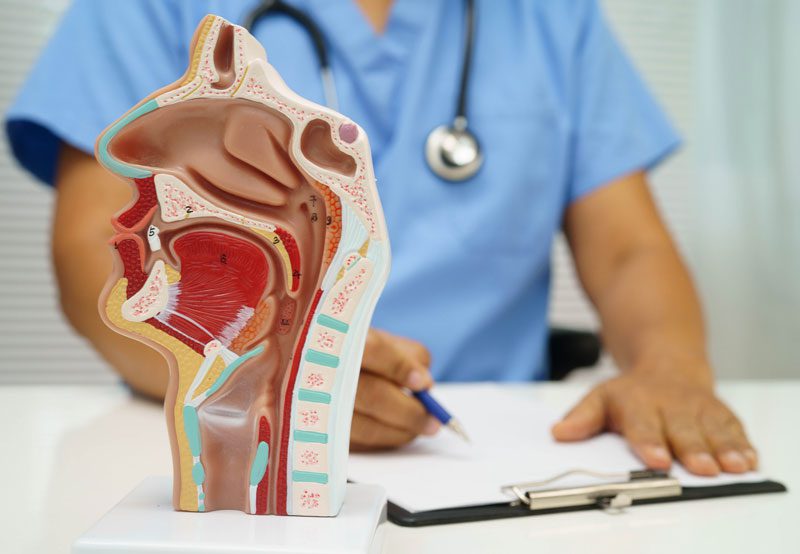
Reconstructive surgery in the head and neck is performed to restore anatomy, function, and appearance following treatment for cancer, trauma, infection, or congenital abnormalities. These procedures are most commonly required after oncologic resection, where removal of disease results in defects affecting speech, swallowing, breathing, facial movement, or structural support. Reconstructive surgery is a core component of comprehensive head and neck care and is often performed at the same time as tumor removal. The overall goal is to optimize functional recovery while maintaining oncologic safety and long-term quality of life.
What It Treats
Reconstructive surgery addresses defects that result from disease or its treatment rather than the disease itself.
- Post-cancer surgical defects: Following resection of tumors of the oral cavity, pharynx, larynx, thyroid, salivary glands, skin, or skull base
- Bone loss: Involving the mandible, maxilla, or facial skeleton
- Soft tissue defects: Affecting the tongue, floor of mouth, cheek, neck, or throat
- Airway compromise: Structural changes that interfere with breathing or airway protection
- Functional impairment: Difficulty with speech, swallowing, chewing, or facial expression
- Traumatic or congenital defects: Resulting from injury or developmental anomalies
Reconstruction is tailored to both the anatomic defect and the functional demands of the affected region.

How the Procedure Works
Reconstructive surgery is planned in close coordination with the primary surgical team to ensure seamless integration with disease treatment. The approach depends on defect size, tissue type involved, and patient-specific factors.
- Preoperative planning: Imaging and multidisciplinary evaluation guide reconstructive strategy
- Local or regional reconstruction: Nearby tissue is repositioned to close smaller or moderate defects
- Microvascular free tissue transfer: Tissue containing skin, muscle, bone, or combinations is transferred from a distant site and reconnected to neck blood vessels using microsurgical techniques
- Structural restoration: Bone grafts or bone-containing flaps are shaped to restore jaw or facial support
- Soft tissue contouring: Recreates internal lining and external contours needed for speech and swallowing
- Integration with oncologic care: Reconstruction is designed to avoid compromising cancer control or future treatments
The choice of technique prioritizes both durability and function.
Benefits of the Procedure
Reconstructive surgery provides essential benefits following complex head and neck treatment.
- Restoration of critical functions: Supports swallowing, speech, and airway stability
- Improved facial symmetry and contour: Restores appearance and structural balance
- Single-stage repair: Often completed during the same operation as tumor removal
- Enhanced healing: Vascularized tissue improves recovery, especially in previously radiated areas
- Quality-of-life improvement: Enables nutrition, communication, and social interaction
Successful reconstruction is closely linked to careful planning and postoperative rehabilitation.
What to Expect
Recovery varies depending on the extent of reconstruction and tissues involved.
- Hospital stay: Commonly required for monitoring healing and airway status
- Temporary support measures: Feeding tubes or tracheostomy may be needed during early recovery
- Donor site care: If tissue is transferred, the donor area requires its own healing and monitoring
- Rehabilitation: Speech, swallowing, or physical therapy is often necessary
- Adjuvant therapy: Radiation or chemoradiation may follow surgery based on underlying pathology
- Gradual recovery: Functional improvement continues over weeks to months
Close follow-up ensures appropriate healing and early identification of complications.
Is It Right for You?
Reconstructive surgery is appropriate for patients whose treatment or condition results in functional or structural deficits that cannot heal adequately on their own. Candidacy depends on the extent of the defect, overall health, prior treatments, and functional goals. Evaluation by a specialized head and neck surgical team allows for individualized planning, coordination with oncologic care, and a clear understanding of expected outcomes and recovery.