

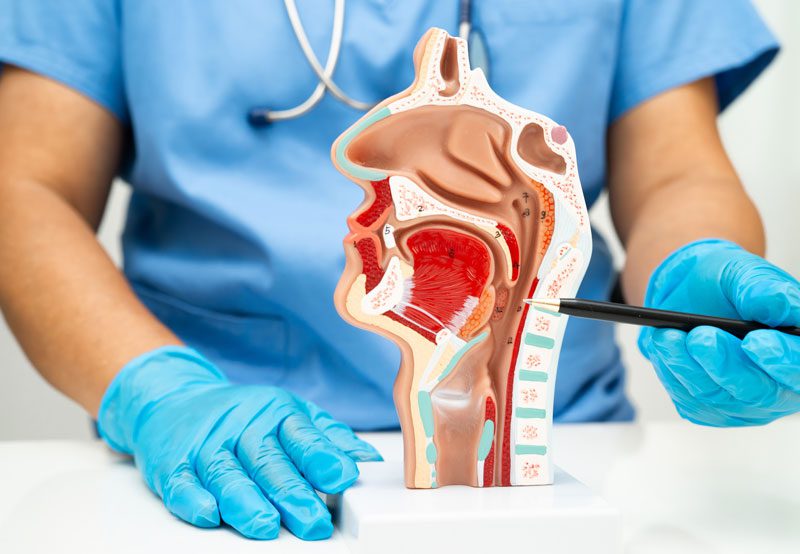
Minimally invasive transoral robotic surgery (TORS) is an advanced surgical technique used to remove tumors of the mouth and throat through the natural opening of the mouth without external incisions. This approach uses robotic technology to provide high-definition, three-dimensional visualization and precise instrument control in anatomically complex areas that are difficult to access with traditional surgery. TORS is most commonly used for select cancers and benign tumors of the oropharynx, base of tongue, tonsils, and supraglottic larynx. The goal of TORS is to achieve effective tumor removal while minimizing disruption to surrounding tissues and preserving speech, swallowing, and airway function.
What It Treats
Transoral robotic surgery is used to manage a range of conditions affecting the upper aerodigestive tract when anatomy and tumor characteristics are favorable.
- Oropharyngeal cancer: Including tumors of the tonsils and base of tongue, particularly human papillomavirus–associated cancers
- Supraglottic laryngeal cancer: Selected tumors above the vocal cords
- Recurrent or residual tumors: In patients previously treated with radiation or chemoradiation, when feasible
- Benign tumors: Such as select tongue base or pharyngeal lesions causing symptoms or functional impairment
- Diagnostic excision: Removal of unknown primary tumors presenting with metastatic neck disease in select cases
Careful patient selection is essential to ensure safe access and complete tumor removal.

How the Procedure Works
TORS is performed under general anesthesia using a robotic surgical system positioned at the head of the operating table. The surgeon controls the robotic instruments from a console while visualizing the surgical field in magnified three-dimensional detail.
- Transoral access: Surgical instruments are introduced through the mouth, avoiding external incisions
- Enhanced visualization: High-definition optics allow precise identification of tumor margins and critical structures
- Precise resection: Robotic instruments enable fine, controlled movements in confined spaces
- En bloc tumor removal: The tumor is removed with appropriate margins when oncologically feasible
- Neck dissection: May be performed during the same operation or in a staged manner when lymph node involvement is present
The approach allows surgeons to operate with accuracy while minimizing trauma to surrounding tissues.
Benefits of the Procedure
Minimally invasive transoral robotic surgery offers several advantages compared with traditional open approaches in appropriately selected patients.
- No external incisions: Avoids visible scars and reduces disruption of surrounding tissues
- Improved functional outcomes: Higher likelihood of preserving speech and swallowing
- Shorter hospital stay: Many patients recover more quickly than with open surgery
- Reduced need for tracheostomy: Lower likelihood of long-term airway diversion
- Potential reduction in adjuvant therapy intensity: In select cancers, surgical pathology may allow de-escalation of radiation or chemotherapy
- Accurate tumor staging: Direct removal allows precise pathologic assessment
These benefits contribute to improved quality of life following treatment.
What to Expect
Recovery after TORS varies depending on tumor size, location, and whether additional procedures are performed.
- Hospital stay: Often shorter than with open surgery, though monitoring is required
- Swallowing changes: Temporary difficulty swallowing is common and typically improves with time
- Diet modification: Soft or liquid diets may be required during early recovery
- Pain management: Throat discomfort is expected and managed with medication
- Rehabilitation: Speech and swallowing therapy may be recommended
- Adjuvant treatment: Radiation therapy or chemoradiation may still be needed based on final pathology
Most patients experience gradual improvement in function over several weeks.
Is It Right for You?
Minimally invasive transoral robotic surgery is considered for patients with tumors that are accessible through the mouth and can be safely removed with clear margins. Candidacy depends on tumor location and size, airway anatomy, prior treatments, and overall health. Evaluation by an experienced head and neck surgical team is essential to determine whether TORS is an appropriate option and to develop an individualized treatment plan focused on cancer control and functional preservation.