

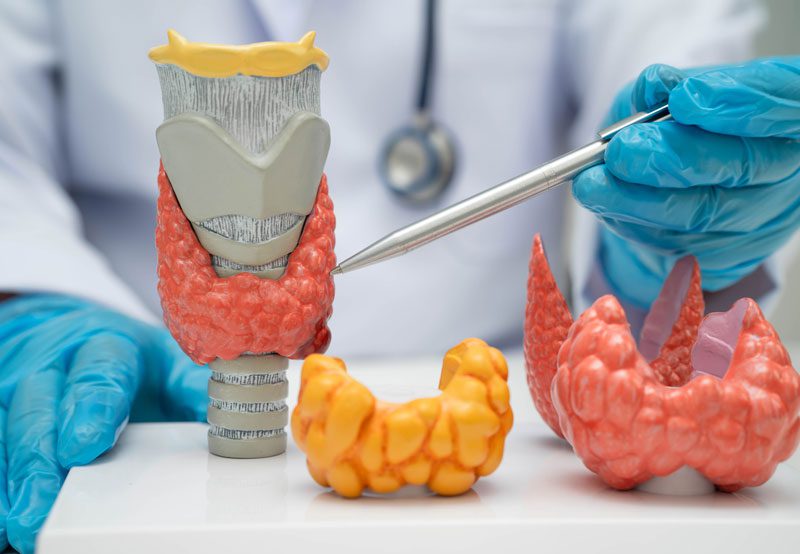
Goiter is the abnormal enlargement of the thyroid gland, a butterfly-shaped endocrine organ located at the front of the neck that regulates metabolism through thyroid hormone production. A goiter may develop when the thyroid is overstimulated, inflamed, hormonally imbalanced, or structurally altered by nodules. Goiters can occur in the setting of normal, underactive, or overactive thyroid function and may range from mild enlargement to large masses that affect surrounding structures. Evaluation focuses on identifying the underlying cause, assessing thyroid function, and determining whether treatment is required.
Causes
Goiter formation reflects an underlying disruption in normal thyroid regulation or structure. Several conditions may lead to thyroid enlargement.
- Iodine deficiency: Reduced iodine availability limits thyroid hormone synthesis, leading to compensatory gland enlargement
- Autoimmune thyroid disease: Graves’ disease and Hashimoto’s thyroiditis commonly cause diffuse thyroid enlargement
- Thyroid nodules: Single or multiple nodules can enlarge the gland unevenly
- Hormonal imbalance: Both hyperthyroidism and hypothyroidism may stimulate thyroid growth
- Thyroid inflammation (thyroiditis): Acute or chronic inflammation can result in transient or persistent enlargement
- Medications or environmental exposures: Certain drugs or dietary factors may interfere with thyroid hormone production
In some cases, no clear cause is identified, and the goiter is classified as idiopathic.

Symptoms
Symptoms depend on the size of the goiter, rate of growth, and associated thyroid hormone levels. Many goiters are asymptomatic and discovered incidentally.
- Visible or palpable neck swelling: Often most noticeable when swallowing
- Neck tightness or pressure: Sensation of fullness in the lower neck
- Difficulty swallowing or breathing: Seen in larger goiters compressing the esophagus or airway
- Hoarseness or voice changes: May indicate pressure on the recurrent laryngeal nerve
- Symptoms of thyroid dysfunction: Such as weight changes, heat or cold intolerance, palpitations, fatigue, or tremor
Rapid growth, pain, or associated lymph node enlargement warrants prompt evaluation.
Diagnosis
Diagnostic evaluation aims to determine the cause of thyroid enlargement and assess functional impact.
- Physical examination: Assessment of thyroid size, symmetry, consistency, and mobility
- Thyroid function tests: Measurement of thyroid-stimulating hormone and thyroid hormone levels
- Ultrasound imaging: Defines gland size, identifies nodules, and evaluates structural features
- Fine-needle aspiration biopsy: Performed when nodules have suspicious features or rapid growth
- Radioactive iodine uptake scan: Used selectively to assess thyroid activity in hyperthyroid states
- Cross-sectional imaging: Computed tomography or magnetic resonance imaging may be used for large or substernal goiters
Diagnosis integrates laboratory findings with imaging and clinical context.
Treatment Options
Management depends on the underlying cause, size of the goiter, symptoms, and thyroid function.
- Observation: Appropriate for small, asymptomatic goiters with normal thyroid function
- Medical therapy: Thyroid hormone replacement or antithyroid medications used to correct hormonal imbalance
- Iodine supplementation: Considered in iodine-deficient settings
- Radioactive iodine therapy: Used in select cases to reduce thyroid size, particularly in hyperthyroid goiters
- Thyroidectomy: Surgical removal of part or all of the thyroid gland is recommended for large goiters causing compression, cosmetic concerns, suspicious nodules, or refractory hyperthyroidism
Surgical management emphasizes preservation of the recurrent laryngeal nerves and parathyroid glands.
When to See a Specialist
Referral to a specialist is recommended for any enlarging neck mass, symptoms of compression, abnormal thyroid function tests, or nodules requiring biopsy. Early evaluation supports accurate diagnosis, appropriate monitoring, and timely intervention, particularly when goiter size or function threatens airway, swallowing, or vocal function.